Mangools review: pricing, KWFinder and who it fits
Mangools combines keyword research, Google results analysis, rank tracking, backlink research and site insights in a single SEO toolkit. But the best reason to buy it depends on the work you need to do—not just the subscription price.
Worth considering if
You run a small website, want keyword ideas with difficulty estimates, and can live with plan-based limits.
Think twice if
You require extensive site auditing, very large research quotas, advanced reporting or multiple simultaneous users on the Basic plan.
Independent, desk-researched guide based on provider documentation; we have not conducted hands-on performance testing or assigned a rating.
Business Service Scout may earn a commission if you create a paid Mangools account after using our labeled partner link. This does not increase your purchase price or buy a favorable review. We also link to independent provider documentation. How we earn revenue ↗
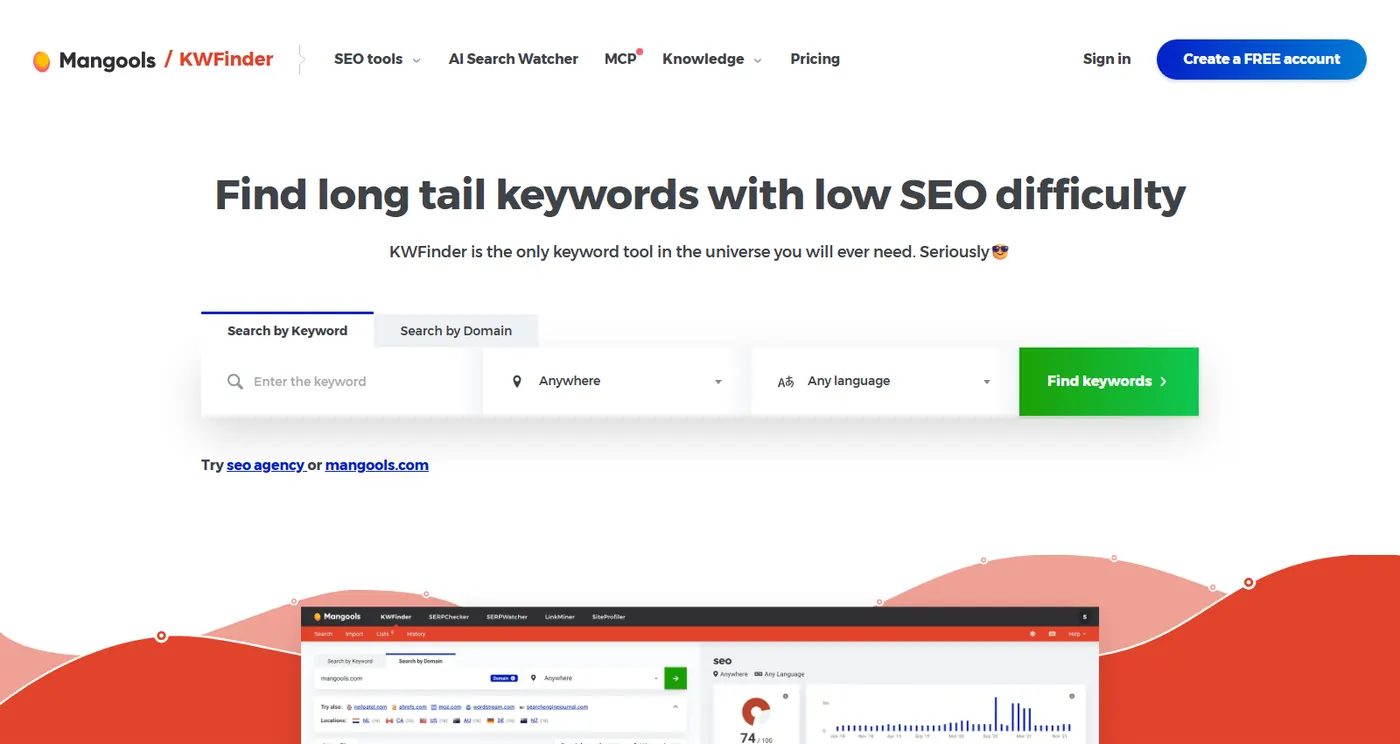
Mangools’ public KWFinder page shows the keyword-research interface and SEO metrics. Captured November 7, 2026; interface details can change. View the current official page ↗
The short answer
Mangools is a sensible shortlist candidate for a small business that wants to learn which keywords to target, check competing search results, and monitor rankings. Instead of buying separate tools for every step, you get a connected workflow. Its main trade-off is usage limits: how many lookups and tracked keywords you need can matter more than the brand name.
For a bakery, local contractor, online store or solo marketer, a typical job might be checking whether “same-day cake delivery” has a realistic search opportunity, reviewing the competing pages, tracking the target keyword, and looking at backlinks to competitors. That is the kind of sequence the suite is built around. None of those metrics guarantee that a page will rank or that a search will become a paying customer.
Mangools pricing and plans in 2026
The official US-facing pricing page showed the following annual-billing figures when checked November 4, 2026. The monthly-equivalent amount is not the amount charged each month on an annual plan—you pay the displayed annual total. Prices may differ by country, taxes, promotions, currency or billing cycle. Confirm the final checkout price before subscribing.
Published annual-billing plan comparison, checked Nov. 4, 2026
Plan
Basic
Premium
Agency
Monthly equivalent with annual billing
$37.70
$52.70
$97.70
Total annual charge shown
$452.40
$632.40
$1,172.40
Keyword lookups / 24 hours
100
500
1,200
Tracked keywords
200
700
1,500
Rank updates
Weekly
Weekly
Daily
Backlink rows / month
100,000
500,000
1,200,000
Extra team seats
0
3
5
The SEO + AI plans currently include KWFinder, SERPChecker, SERPWatcher, LinkMiner, SiteProfiler and AI Search Watcher Pro. The provider also sells AI Search Watcher separately with much smaller SEO-tool allowances. Don't confuse those products.
Which plan is the practical starting point?
Basic is the first tier to evaluate for an owner researching a single site. Premium makes more sense if you frequently hit the Basic lookups or need additional seats. Agency is the tier to check when daily tracked-ranking updates or higher-volume client work matter. You should not upgrade solely because more capacity sounds better; decide using actual workload.
Search for phrases customers may type, review demand estimates and keyword difficulty, discover related and longer-tail phrases, and compare against competing sites. For a local business, it's a way to narrow a long list of possible topics—not proof that any one keyword will convert.
Watch for: daily lookup limits, suggestions per lookup, and the location or language selected.
SERPChecker — search-result research
Look at who currently ranks in Google for the phrase and examine page- and domain-level signals. This helps distinguish a search dominated by major publishers from one where a genuinely helpful small-business page could compete.
Watch for: the difference between results in different cities or on different devices.
SERPWatcher — rank tracking
Track a selected keyword list over time rather than manually searching Google every day. Because Basic and Premium update rankings weekly, this is useful for monitoring trends but is not a real-time position feed.
Watch for: how each location and device uses a tracked-keyword slot.
LinkMiner — backlink research
Examine links pointing to a competitor or page, then decide whether any relevant publishers or associations might reasonably link to your own genuinely useful resources. This is research—not an invitation to buy spam links.
Watch for: the monthly cap on backlink rows.
SiteProfiler — quick site overview
Review high-level website signals, backlinks and related sites when you're evaluating competitors or potential partners. It is an overview tool, not a substitute for fixing performance, accessibility or technical problems on your own website.
Watch for: site-analysis lookup limits.
AI Search Watcher — AI visibility monitoring
Track whether and how supported AI search systems mention a brand in responses to monitored questions. It is an additional research angle, separate from Google organic rankings. The main SEO + AI plans currently include AI Search Watcher Pro.
Watch for: prompts, monitors and how often results are refreshed.
A realistic first-week workflow for a small business
Suppose you own a mobile car-detailing business. You want an article that answers a customer question and could eventually generate enquiries. Rather than chasing “car detailing” because it sounds popular, try a more specific question connected to a service you can actually deliver.
Write down five customer questions. For instance, “how long does interior car detailing take” or “what to do before mobile car detailing.” Start from the questions customers ask you in messages or calls, not just keyword software.
Use KWFinder to expand your ideas. Look at relevant variations, estimated interest, location, and difficulty. Discard searches that do not fit your services or your customers.
Open SERPChecker for promising phrases. Read the actual competing pages. If they already answer the question well, plan something more useful—such as a real checklist, a before/after explanation, or details from work you have actually performed.
Publish one genuinely helpful page. Explain the process plainly, use your own experience where available, answer pricing and timing questions carefully, and offer the logical next step without forcing a sales pitch.
Track a small set of relevant phrases in SERPWatcher. Review trends on the plan's schedule; don't treat normal daily fluctuations as a reason to rewrite the page.
Evaluate outcomes beyond rank. Google Search Console can show impressions and clicks. Your own analytics can help show whether people engaged or contacted your business. Rankings alone do not pay the bills.
That workflow makes a lightweight SEO toolkit useful. If the business has no time to act on the research, even an affordable subscription may not offer value.
What Mangools does well—and what it doesn't replace
Reasons to consider it
Keyword ideas, Google result research and rank tracking form a logical workflow.
Clear usage tiers help a small team decide how much research capacity it needs.
Competitor and backlink views give context beyond a simple search-volume number.
Official free SEO utilities can be tried before committing to a paid plan.
Reasons to compare alternatives
Basic may feel restrictive if you research many sites or keywords every day.
Rank tracking is weekly on Basic and Premium, not daily.
Deep site-crawling audits and broad marketing operations are not its central focus.
Adding more seats or managing many client projects may require a different tier or product.
Mangools vs Semrush—and other ways to do the job
Mangools vs Semrush: If your job mainly involves research, SERP checks, rank monitoring and backlinks, Mangools is worth comparing on total monthly cost and the limits you will actually use. Semrush is a broader SEO and marketing platform with additional site-auditing, project and reporting functionality. That scope can be helpful, but you may not need it to run a small local business site.
Semrush vs Mangools: which SEO tool fits a small business? ↗ for the practical differences. For a business that only needs to see which search terms are bringing Google traffic, Google Search Console is a free starting point. It does not provide the same research suite as Mangools, but it can prevent paying for a tool before you have a clear use for it.
Buying checklist: what to verify at checkout
Billing: Are you comparing annual total cost to a monthly subscription? Which taxes or currency adjustments apply?
Capacity: How many keyword searches, SERP checks, rank slots and site lookups will you realistically use?
Update cadence: Is weekly keyword tracking enough, or is daily monitoring essential?
Team access: Does the selected plan allow the number of colleagues who need a login?
Workflow: Will you act on research insights each month, or could free Search Console reports meet the immediate need?
Current terms: Check cancellation rules, trial eligibility, limits and final total directly on Mangools' website.
These are the checks we recommend making before subscribing, not a prediction of results or a claim that every business needs paid SEO software.
NEXT STEP
Is Mangools a fit for your SEO workload?
Review the live plan details and compare the included limits against the number of keywords and sites you actually manage. This is an affiliate link; we may earn compensation if you become a paying customer.
At the official pricing page checked November 4, 2026, annual billing showed monthly-equivalent prices of $37.70 for Basic, $52.70 for Premium and $97.70 for Agency, with annual charges of $452.40, $632.40 and $1,172.40 respectively. Monthly billing and regional pricing can differ. Confirm the live total at checkout.
Is Mangools the same thing as KWFinder?
No. KWFinder is Mangools' keyword-research tool. The broader Mangools account also includes SERPChecker, SERPWatcher, LinkMiner and SiteProfiler, with AI Search Watcher included in current SEO + AI plans.
Does Mangools have a free version?
Mangools offers free SEO utilities with limited usage, and a free account can unlock more of some tools. Its full research and tracking capacities are tied to paid plans. Check which features are free before assuming an unlimited free tier.
Is Mangools good for a small local business?
Potentially, especially when you regularly research local-service questions and can use the findings to publish or improve helpful pages. For a business with no time to follow through, Search Console and other free tools may be a better first step.
Does Mangools check Google rankings every day?
Its SERPWatcher tracks selected keywords. As of the provider documentation checked November 4, Basic and Premium update weekly while Agency updates daily. The plan and location/device settings affect the monitoring allowance.
Can Mangools guarantee first-page Google results?
No. Search rankings depend on competition, relevance, website quality, and factors no SEO software can control. Keyword difficulty and search-volume estimates are guides, not promises.
Is this a hands-on Mangools review?
No. This page compares official published documentation with common small-business SEO needs. We have not conducted independent speed, data-accuracy or usability testing, so we do not claim to have tested Mangools personally.
Does Business Service Scout earn a commission?
Yes, it may earn a commission when a qualifying customer signs up through the labeled Mangools affiliate link. This does not affect our published comparison criteria. Read our affiliate disclosure.
Sources and editorial notes
Checked November 4, 2026. Our guide draws on Mangools' published pricing, plan-limit reference and tool explanations. We have not independently audited Mangools' keyword databases or tested its ranking accuracy. Prices, discounts, limits and available features can change after this check.
PRACTICAL SEO WORKFLOW
Want to use KWFinder without getting lost in keyword lists?
Our KWFinder small-business workflow shows a simple process for choosing realistic topics, checking intent and building useful content clusters.